(2).gif?w=300&h=250)
The first thing people notice is not the colour, the lining, or even the amount it holds. It is the moment the button is pressed.
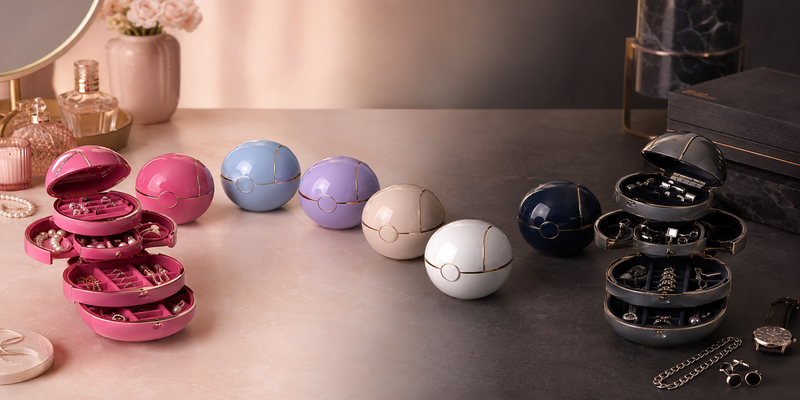
At rest, the object is closed, rounded, and almost secretive. Then a thumb meets the circular release. The upper shell rises. Side sections move away from the centre. Layer after layer becomes visible until the sphere has turned into a small display tower. The transformation takes only seconds, but it changes the entyre way the product is understood.
This is not a decorative trick added after the storage was designed. The movement is the storage system. The closed sphere keeps the object compact. The opening action creates the extra viewing area only at the moment it is needed.
For decades, jewellery storage has been dominated by the same visual language: rectangular cases, stacked drawers, hinged lids, and internal trays. Functional, certainly. But most of them demand a compromise. Leave them open and the room looks busy. Close them and everything disappears.
Press the button. Step back. Watch a sealed sphere become a layered display. There is no drawer-by-drawer search and no stack of trays to remove first.
The quiet problem with “organised” jewellery
Jewellery is unusually difficult to store because its pieces behave differently. Rings are small and dense. Chains are long and easily tangled. Earrings come in pairs but rarely stay together. Bracelets occupy broad, shallow space. Watches are rigid, heavy, and awkwardly shaped.
A single empty drawer treats all of these objects as though they were the same. They are not. The result is familiar: pieces migrate, chains overlap, earrings disappear under bracelets, and the item worn most often ends up sitting on the tabletop because returning it to the box takes too long.
The Deep-Drawer Search
When every piece sits below the same opening, the objects at the bottom become invisible until the top layer is moved.
The Chain Tangle
Long, flexible pieces naturally overlap when they share an undivided compartment.
The Dressing table Trade-Off
Large boxes can hold more, but their rectangular mass often becomes the dominant object on a small dressing table.
The Forgotten Collection
Jewellery that cannot be seen is worn less often—even when it is stored only a few centimeters away.
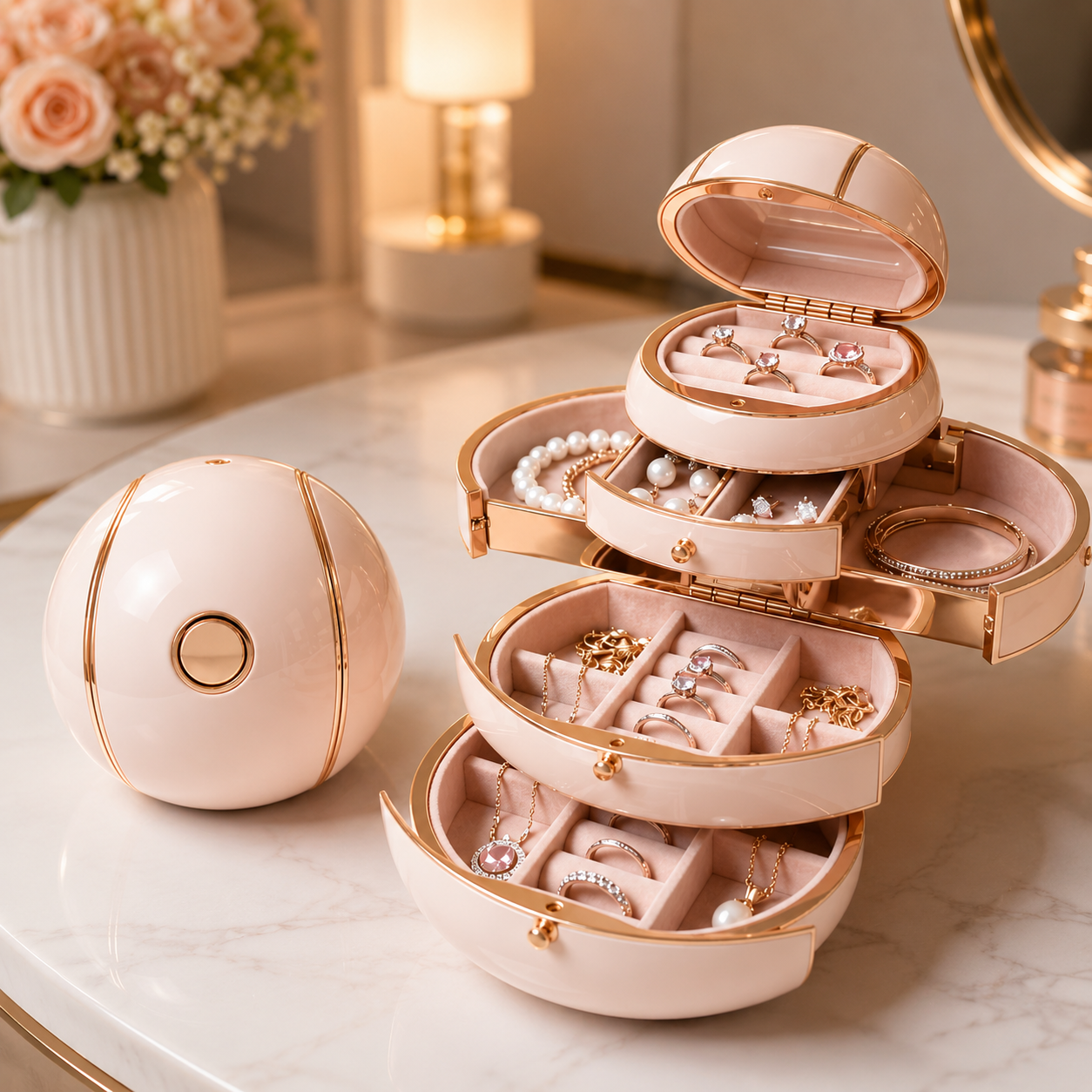
The button is not a detail. It is the whole design.
Most jewellery boxes ask the hand to do all the work: open one lid, pull one drawer, lift one tray, then repeat. This design concentrates the beginning of that sequence into a single, satisfying action.
Press the circular release button and the internal spring-powered, multi-link structure begins to separate the spherical shell. The upper section lifts, the side compartments move outward, and the inner storage levels are revealed in sequence. What looked like one compact volume becomes a broad, vertical arrangement of trays.
The movement is mechanical. No charging cable is needed for the opening action, and there is no electronic interface between the user and the object. The tactile press leads directly to visible movement.
The shift is more significant than it first appears. A traditional box keeps its external volume essentially unchanged whether it is being used or not. This design separates those two states. It is compact during storage and expansive during selection.
That is the central idea: the box does not need to dominate the tabletop all day simply because you need visibility for a few minutes in the morning.
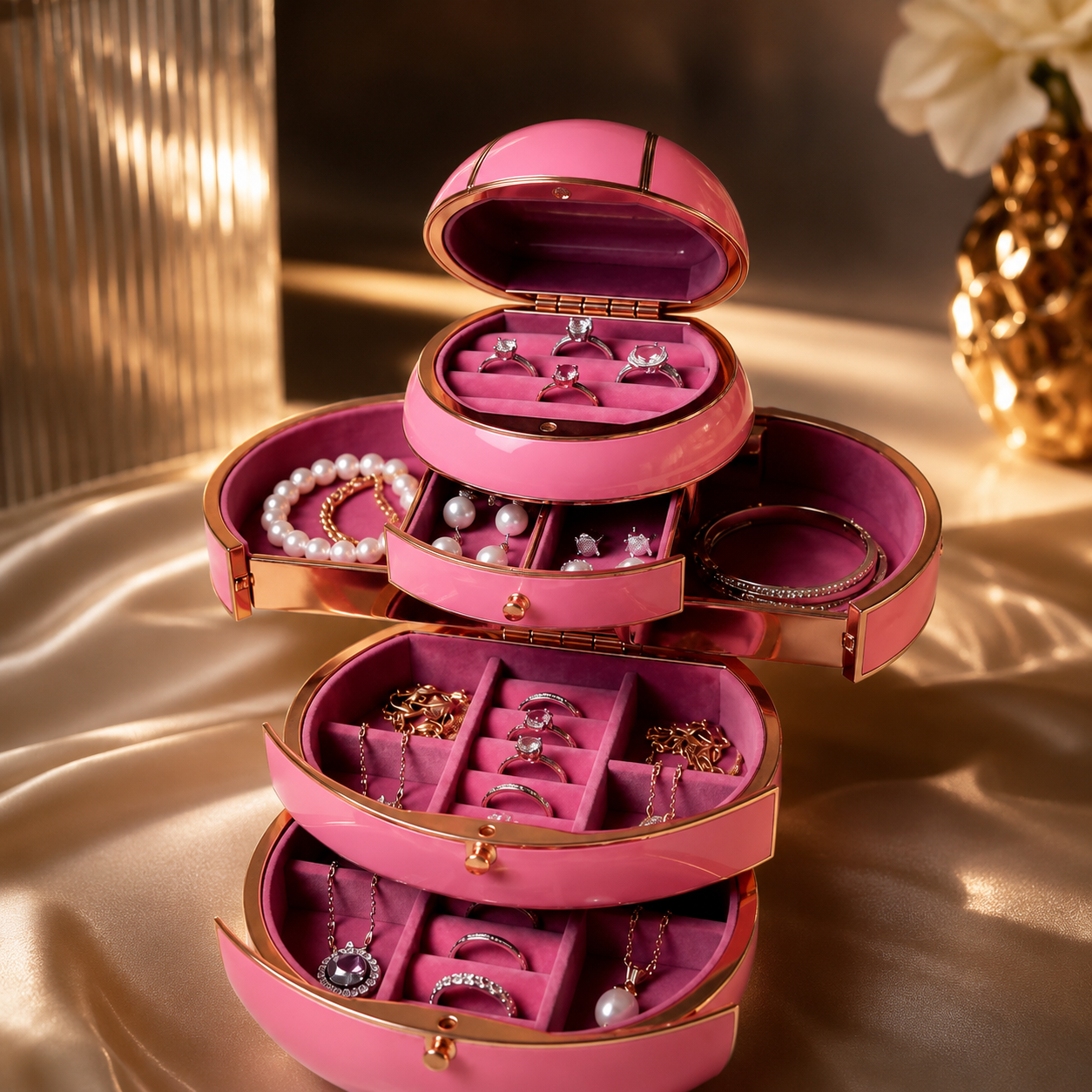
The sphere is not a novelty. It is the storage strategy.
When closed, the curved shell creates a contained, decorative profile. When opened, the linked levels move apart so rings, chains, earrings, bracelets, and watches can occupy separate viewing zones.
The design changes its footprint according to the moment: smaller when resting, wider when working.
Why the unfolding motion matters beyond the surprise
Compact outside, layered inside
The spherical shell conceals multiple storage levels, reducing visual clutter when the organiser is closed.
The button begins a complete reveal
The listed spring-powered, multi-link mechanism turns one press into a coordinated opening sequence, allowing several storage levels to emerge rather than requiring each compartment to be opened separately.
No single bottom layer
Extending the compartments outward makes more of the collection visible at the same time.
Different pieces get different spaces
Divided areas help keep compatible rings, earrings, chains, bracelets, and watches from collapsing into one pile.
Velvet-lined storage areas
The listed soft lining creates a gentler contact surface than bare hard plastic or metal during ordinary storage.
A box that does not look like a box
The curved exterior allows the organiser to read as a tabletop accent rather than a stack of utility drawers.
None of these decisions eliminates the need to handle jewellery carefully. Delicate, plated, antique, gemstone, or high-value pieces should always be stored according to their maker’s care guidance. No storage box can universally prevent tarnish, oxidation, or environmental damage.
But the design can improve the ordinary moment between opening a box and choosing what to wear. That is where many storage products fail—not because they cannot hold jewellery, but because they make access unnecessarily slow.